
:format(webp))
Companies rarely look for a Langdock alternative because the product does not work. Langdock is based in Berlin, hosts in the EU, is ISO 27001 certified, SOC 2 Type II audited, and bundles more than 40 models into a single interface. Either the procurement process requires several alternatives to be compared, or the company searching has requirements Langdock does not meet.
Usually it is one of the following:
a cost model that scales differently from per-seat licensing once several thousand users are involved,
far-reaching control over the specific context of your own organization and teams,
collaboration between teams and AI.
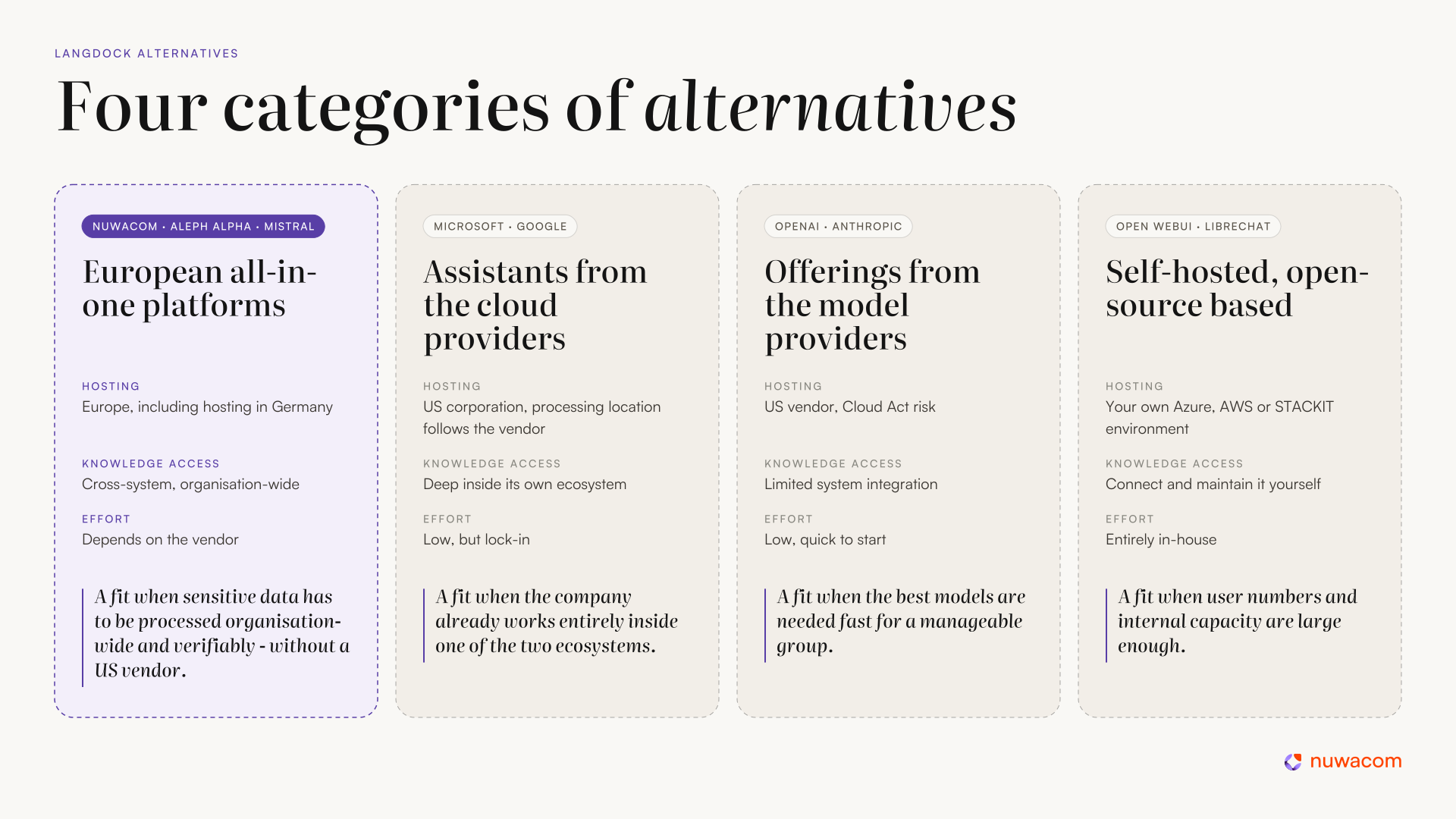
There are four fundamentally different categories of alternatives. Integrated European platforms with their own knowledge layer, assistants embedded deep in the Microsoft or Google ecosystem, the offerings of the large model providers, and self-hosted open-source deployments. Which category is the best option for a given company depends on six criteria that are largely independent of the vendor. Model selection is generally not among them.
Model Variety Is No Longer a Selection Criterion in 2026
Two years ago, the question of which models a platform offered was genuinely decisive. Today, every serious vendor delivers models from OpenAI, Anthropic, Google and Mistral through the same interface, and some also offer efficient, high-performing open-weight models. The available lineup changes every few weeks anyway.
What differs is the surrounding layer: which data the model is allowed to see, who controls that, how results are reused across the company, and what happens when usage grows from 200 to 5,000 people.
Anyone who sorts a shortlist by model selection is looking at the criterion that converges fastest. The more useful preliminary question is which task actually requires which model.
Six Criteria That Actually Decide the Selection
1. Operating Model and Server Location
This is where the vendor landscape splits. "EU hosting" has become standard and says very little. The relevant questions are more concrete: is a data center inside the EU sufficient? Does the platform have to run in your own cloud subscription? Is on-premises a hard requirement?
The point regularly overlooked in RFPs is the minimum user count for dedicated single-tenant deployments. Bring-your-own-cloud (BYOC) and on-premises only become available above a certain size at most vendors. At Langdock, that threshold is 2,000 licenses for single-tenant and 5,000 for BYOC and on-premises; at nuwacom it is 250 licenses for single-tenant, 2,000 for BYOC and 4,000 for on-premises. For a company with, e.g., 2,500 employees and a sovereignty mandate, that can decide the shortlist before anyone has looked at a single feature.
2. Company Knowledge and Context
This is the difference that is least visible in a demo and matters most in daily operations.
The simple variant is a folder inside the platform into which files get uploaded. It scales only for narrowly defined use cases and creates a second knowledge repository alongside the existing one. The more demanding variant sits on top of the systems the company already uses and makes their content searchable and citable. At nuwacom, the Context Engine handles this together with the connectors to Microsoft 365, SharePoint, OneDrive, Outlook, Google Drive, Slack, Confluence and others.
Check at this point whether vendors are connecting organization-wide knowledge or talking about a user-level memory function. Product materials describe both in similar terms, but the consequences are entirely different. Knowledge that only lives in one person's account does not help the company. In most cases, wrong or incomplete answers originate exactly here.
3. Governance and Permissions Model
Three things matter: does the platform inherit the permissions of the connected source systems, or does a second permissions model have to be maintained? Can departments, projects and confidentiality levels be cleanly separated? And is usage logged so that it can be presented to internal audit and regulators?
For organizations with several business units, separating work into self-contained areas with their own members, their own knowledge, and their own rules is more important in practice than any individual feature. At nuwacom, this is controlled through workspaces, user groups and sharing permissions.
4. The Cost Model and How It Scales for You
Three models are common:
A per-user license with automation and API billed separately,
a per-user license with an included usage allowance plus a central, company-wide budget, and
a user-independent flat fee, as charged by vendors deploying into the customer's cloud.
None of these models is inherently cheaper. What decides the outcome is the ratio of heavy to occasional users and the share of consumption generated by agents and workflows rather than by people. When a large part of the work runs automatically, a pure seat model behaves differently from a centrally managed pool. nuwacom's pricing structure combines three license tiers starting at 25 euros per user per month with an optional central AI budget that can be allocated flexibly across users, agents and workflows.
5. Capabilities Beyond Chat
Chat, Skills, agents and workflows are now offered by almost every vendor. The differences show up in the tooling beyond that. Two capabilities tend to surface late in evaluations and then weigh heavily on the decision.
Does the platform let you create internal applications in natural language and run them inside the platform? This makes it possible to build custom business software, from an interactive data dashboard to specific applications for individual departments, without setting up an IT project or buying new SaaS for niche use cases.
The second is an integrated meeting notetaker whose output lands directly in the AI's knowledge base. Virtual and in-person meetings become context automatically, which the AI can then work with: creating tasks, updating documents, preparing follow-up emails.
As of September 2026, Langdock does not offer equivalent capabilities. Whether that matters to you depends on how many decisions are made in meetings and how often your teams resort to workarounds because no standard tool fits.
The reverse also applies. Anyone who needs maximum model control needs bring-your-own-keys. Langdock offers this; nuwacom, as of September 2026, does not.
6. Regulatory Evidence
ISO 27001 and a GDPR-compliant data processing agreement are table stakes in this category, not a differentiator. It gets interesting with the industry-specific evidence: a supplementary agreement for professionals bound by confidentiality under § 203 StGB and the DORA classification for financial services, SOC 2 Type II if your group policy requires it, and documentation on classification under the EU AI Act.
An overview of the security architecture, tenant separation and encryption is equally essential during vendor selection.
Langdock Alternatives in Four Categories
European Full Platforms With Their Own Knowledge Layer
There are several European alternatives to Copilot, among them nuwacom, Aleph Alpha with PhariaAI, and Mistral with Le Chat Enterprise. All of them offer development and operation in Europe, functionality beyond pure AI chat, and cross-system knowledge access.
Their emphases differ considerably. Aleph Alpha focuses on individually trained LLMs and deep technical integration into existing IT, which makes the solution highly bespoke but the implementation comparatively demanding. Mistral brings its own European-built models, allows training of custom models, and offers dedicated tooling for developers.
nuwacom is specialized in mid-sized companies and provides access to different models and tools through a central, easy-to-use interface. Customers can use current models from Anthropic, Google and OpenAI as well as open-weight models operated in Europe such as Kimi K3, GLM 5.3 and DeepSeek V4. Beyond chat, users can create Skills, build agents and workflows, and build apps.
nuwacom also provides a central Context Engine that makes the knowledge of the organization and its people structurally usable for the AI, independent of the model in use. Workspaces allow clean tenant separation. Deployment options are broad and include hosting on German soil.
A solution in this category fits when sensitive data needs to be processed organization-wide and verifiably, when several departments are meant to work with one secure, central solution, and when avoiding a US vendor is part of the requirement.
Assistants From the Large Cloud Providers
Microsoft 365 Copilot and Google Gemini Enterprise are deeply integrated into their respective ecosystems. The advantage is obvious: if you already work entirely inside one of the two ecosystems, you get an AI solution embedded in the interfaces your people already use.
The price you pay is your dependency on large US tech corporations. Model selection, data processing location and feature scope follow the vendor's strategy, and the lock-in effect is not negligible. For companies whose sovereignty requirements are the reason they started looking for an alternative, this category does not solve the original problem.
Offerings From the Model Providers
ChatGPT Enterprise and Claude Enterprise make sense when the actual requirement is: the best possible models, as fast as possible, for a manageable group. Both also offer dedicated tooling for software developers.
They are less suitable when company knowledge has to come together from many systems, when the AI environment has to work in an integrated way across diverse systems, or when the search is for a European alternative without Cloud Act exposure.
Self-Hosted Open Source
Solutions based on Open WebUI or LibreChat, operated in your own Azure, AWS or STACKIT environment, sometimes packaged by specialized service providers. Maximum control, no per-seat license, full data ownership.
The effort shifts in-house. Operations, updates, security, support and the ongoing development of knowledge integration and automation sit with you or your service provider. This pays off with very large user numbers and sufficient internal capacity. Without a dedicated team, the presumed cost advantage quickly turns into a project nobody develops further. The most common reason AI projects fail is not the technology anyway.
Where nuwacom Fits and Where It Does Not
nuwacom belongs to the category of European full platforms and is a sensible option when several of the following apply:
Your company knowledge is distributed across systems such as SharePoint, Google Drive, Confluence, your CRM and email, and should become retrievable organization-wide while respecting existing access rights.
Your daily work is collaborative, and the output of your people and teams should flow back into company knowledge instead of ending up in private chat histories.
Meetings are a core part of how you work and the place where many decisions are made.
Hosting in Germany is a procurement requirement, not a preference.
You need dedicated deployments with fewer than 5,000 users.
nuwacom customers come from industries including aviation, banking and finance, consulting, and tax advisory and audit. The case studies give a deeper insight into how these organizations work with nuwacom.
Case Studies from Selected nuwacom Customers
nuwacom is not the right choice when bring-your-own-keys is a hard requirement, or when you are primarily looking for a solution for software developers.
When Langdock Remains the Better Choice
Two cases are unambiguous. First, when technical teams bring their own provider keys and want to pay model providers directly. Second, when SOC 2 Type II is a required certification.
A direct comparison of nuwacom and Langdock, dimension by dimension, is available in this detailed piece.
Three Steps to a Defensible Shortlist
First: write down your requirements before you compare vendors. Server location, minimum user count for the deployment you want, required certifications, and the functions and capabilities you need in daily work. This list usually narrows the field considerably on its own.
Second: record which systems are essential to your work and which of them an AI solution should integrate with in order to support that work productively. Also record which systems hold the bulk of the relevant company knowledge that should be available to the AI as context. Then ask each vendor how they connect that knowledge and those data sources.
Third: test with your own data, not with the vendor's demo dataset. Connect a real source system and ask ten questions your department actually has. This is where the difference between vendors becomes visible, and nowhere else.
If you want to run that test with nuwacom, you can try the platform for free or book a demo with one of our AI experts.
Frequently Asked Questions
Which alternatives to Langdock exist for companies in Germany?
The alternatives fall into four categories. European full platforms with their own knowledge layer, such as nuwacom, Aleph Alpha PhariaAI and Mistral Le Chat Enterprise. Ecosystem-bound assistants such as Microsoft 365 Copilot and Google Gemini Enterprise. Direct purchase from model providers via ChatGPT Enterprise or Claude Enterprise. And self-hosted open source in your own cloud. Which category fits depends on whether AI is being introduced organization-wide or individually.
Why do companies look for a Langdock alternative?
In most cases because of a requirement that surfaces during procurement: hosting exclusively in Germany, dedicated deployments below 5,000 users, access to knowledge in existing systems rather than uploaded folders, or a cost model that behaves differently under heavy automation than per-seat licensing does.
Which Langdock alternative offers hosting in Germany?
nuwacom offers hosting exclusively in Germany via STACKIT as well as deployments on IONOS, plus bring-your-own-cloud and on-premises. Vendors operated inside the customer's cloud also meet this requirement, but shift the operational load into the company. The current status should be verified with the vendor in each case.
Which alternative is suitable for regulated industries?
The industry-specific evidence decides this, not the general certifications. For professionals bound by confidentiality, a supplementary agreement under § 203 StGB is relevant; for financial services, the DORA classification. nuwacom provides both and documents the classification publicly. Further detail is in the piece on § 203 StGB and DORA.
Is migrating from Langdock a large effort?
The effort depends on how much knowledge sits inside the platform itself. One of our partners has built a practical migration guide.
What role does model selection play in the decision?
A smaller one than most selection processes assume. Every relevant vendor delivers models from OpenAI, Anthropic, Google, Mistral and Cohere. The differences arise in knowledge access, governance, cost model and capabilities beyond chat.
Try nuwacom free for 7 days, no commitment, or book a personal demo with one of our AI experts.