
:format(webp))
:format(webp))
This comparison was written by Thomas Euler, GTM Architect at nuwacom, and last reviewed on 24 July 2026. We have done our best to represent Langdock accurately based on publicly available information as of July 2026. Where Langdock is the better fit, we say so.
If you are evaluating AI platforms this year, you have probably noticed that the model layer is no longer where the decision gets made. Every serious vendor now offers the models of Anthropic, OpenAI, Google, and others behind one interface. nuwacom and Langdock are no exception: both are EU-built, both clear the GDPR and ISO 27001 bar, and both give you several frontier models in one place.
So the question to ask isn't "which one has the better AI?" anymore, it is "which architecture matches how your organization actually works." That is what this piece compares. In both cases, we look only at what is publicly available today - and where Langdock is the stronger choice, we say so.
Where nuwacom and Langdock are evenly matched
A fair comparison starts with the ground both platforms share, because there is a fair bit of it.
Both run multiple frontier models and a selection of smaller models, including open-weight and image generation models. Both have mature agent and workflow tooling, including visual workflow builders, webhook triggers and MCP support. Both connect to more than 100 business systems, with Langdock's integration catalogue slightly broader. Permission management is roughly on par, with Langdock offering marginally more customization. And both platforms are built in the EU on an ISO 27001:2022 and GDPR foundation.
Getting started
For the hosted SaaS deployments both offer, every instance works out of the box with no infrastructure setup required. Both companies provide a customer success team, including technical implementation support, and enablement sessions during the rollout. For deeper rollouts, both nuwacom and Langdock work with implementation partners who help build agents and workflows and train staff.
Work starts in a shared space, not a private chat
The clearest design difference is visible the moment you start using each platform.
In nuwacom, people do not begin alone in a one-to-one chat with an AI. They start in a shared workspace, where team members, agents, shared knowledge, and shared tooling all sit together. Documents can be co-edited in real time and shared natively inside that workspace. Different teams and departments can have their shared workspaces and collaborate seamlessly. Langdock has sharing features for individual chats, projects, and agents, but in nuwacom, collaboration is the underlying design premise.
The consequence for a buyer is structural, not cosmetic. When work starts in a shared environment, collaborative output compounds as a team asset. When it starts in a private chat, that same output tends to stay trapped in individual histories that no colleague can see, reuse, or build on. For an organization adopting AI as a team capability rather than a collection of personal productivity gadgets, the starting point matters far more than it first appears.
nuwacom fits you if your teams produce work together and you want AI output to accumulate as a shared asset. If most of your AI use is solo and private by nature, this weighs less.
Organizational knowledge the AI can use
The second difference is about knowledge at the scale of an organization rather than an individual. It is an architectural difference worth being precise about.
nuwacom provides a centralized knowledge base, the Context Engine, built as a distinct retrieval architecture. When you connect a data source such as SharePoint or Google Drive, it passes through nuwacom's ingestion pipeline, which combines methods such as metadata creation, retrieval-augmented generation (RAG), and vector search to make company data retrievable, findable, and citable for the model inside nuwacom. A single query can surface the right answer, wherever it actually lives - without using any tokens - rather than relying only on what one person has loaded into their own session.
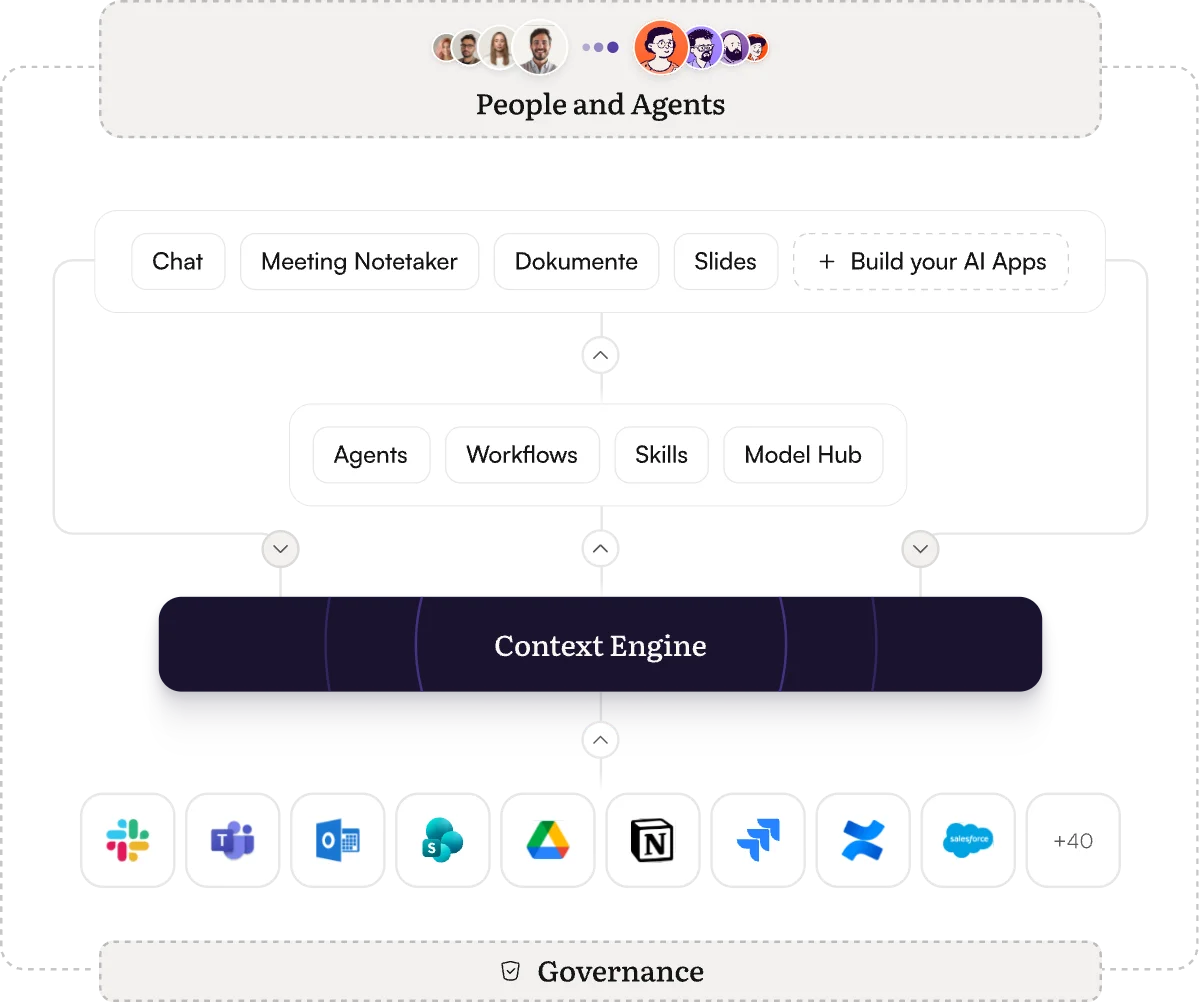
It is important to be exact about what this is and what it is not. The Context Layer is not a per-user "memory" feature. Langdock documents a Memory feature, but it is a limited, personal one: it is per-user, stored in the individual's account, and disabled inside agents. That is a narrower feature; a useful one, but it is not equivalent to an organization-wide retrieval layer.
The context engine is also markedly different from Langdock’s folder and knowledge base features. Those are folders with files uploaded to Langdock, while nuwacom’s context engine sits on top of the file systems the company already uses and can handle uploaded data on top of that. Based on their public documentation as of July 2026, Langdock does not offer a centralized enterprise-knowledge layer of the kind that the Context Engine provides.
The practical effect is knowledge-retrievability at the organizational level instead of knowledge fragmented into per-user silos. As the volume of AI-assisted work grows, the ability to work with the knowledge and data across the systems that a company already runs becomes one of the more decisive advantages.
nuwacom fits you if your institutional knowledge is scattered across systems like SharePoint or Google Drive and you need answers retrievable across the whole organization, not just per person. If your knowledge already sits in one place, the gain is smaller.
Open model access and direct API control
Both offer a unified API. But Langdock has one capability outright that nuwacom does not match today (it’s on our roadmap but not yet implemented): a bring-your-own-keys (BYOK) and "add your own models" setup. Its model-agnostic core lets you connect your own provider keys (Azure, Anthropic, Google), pay the provider directly, and keep full control over which models run where.
That flexibility is genuinely useful, particularly for solo operators and technical teams who want to optimize model cost on a per-task basis. If maximal model and API control is your first priority, that is a real point in Langdock's favor.
Langdock fits you if you have technical teams or solo operators who want to bring their own provider keys, pay providers directly, and control which models run where.
Meetings as a built-in capability
The third difference is in how both platforms integrate with meetings.
nuwacom ships a native AI notetaker as an included capability: live recording, transcript, summary, decisions, and action items, handling meetings and transcripts of virtual meetings (up to two hours) and live meetings (unlimited). Meeting results are instantly stored in the knowledge base and, thus, become a resource the AI can work with. As of July 2026, Langdock has no documented meeting notes feature that can feed into an organization's knowledge base.
This matters because meetings are where a large share of organizational decisions are taken. Capturing them natively, inside the same workspace where the follow-up work then happens, closes a loop that otherwise depends on a separate tool and a manual handoff. Together with the collaboration model, this is the cleanest single capability that distinguishes the two platforms.
nuwacom fits you if meetings carry a real share of your decisions and you want to capture them and follow-up in one place, without bolting on a separate notetaker. Less relevant if you have already standardized on a dedicated meeting tool that you are happy with.
Building your own business apps inside the platform
Only one of the two platforms allows you to build your own business applications in natural language. That is a critical differentiator.
nuwacom Apps lets a business user describe an internal tool in plain English (or most other languages) and have nuwacom write, test, and run it in a secure sandbox inside the platform - no developers, no repository, no deployment pipeline.
What makes this more than a general vibe-coding tool is where the resulting app lives: nuwacom Apps run directly inside the platform, so they can read from the Context Engine, call your skills, and write back into your systems that already own your data through connectors. Apps inherit the permissions those systems enforce and create no shadow databases.
The result: teams can build their own tools in minutes, rather than having to hope for a months-long software project will get approved. You can learn more about nuwacom Apps here.
As of July 2026, Langdock offers no comparable feature that allows building and running business apps directly on their platform.
nuwacom fits you if your teams keep improvising around processes that no off-the-shelf tool fits, and you want them to build governed internal software without turning each one into an IT project. Less relevant if your process gaps are already well covered by existing systems.
Sovereignty and security
For a buyer operating under German or European compliance, security and sovereignty are critical.
nuwacom and Langdock both offer ISO 27001:2022, GDPR, a data processing agreement, EU hosting, AES-256 and TLS encryption, and per-client isolation with dedicated storage and an isolated vector database for customers with BYOC or on-premise deployments, along with a Professional Secrecy Addendum (Berufsgeheimnisträger-Zusatzvereinbarung). Both also meet the DORA requirements.
Beyond that, nuwacom supports pure Germany-based hosting via StackIT, which Langdock does not offer. This matters most for regulated institutions, such as banks, health insurers, and law firms, where German-soil hosting and per-client isolation are often a procurement requirement rather than a preference. nuwacom's StackIT-based hosting is built for exactly that constraint.
To be fair on the certification axis, Langdock publicly documents SOC 2 Type II and ISO 27001 certifications.
As of July 2026, nuwacom does not hold SOC 2 certification; it is on our compliance roadmap but not yet in place, and we note it here plainly rather than imply a status we cannot yet claim.
Both offer various deployment options, but nuwacom has lower user-minimums for bring-your-own-cloud (2,000 users), and on-premises deployments (4,000 users). The comparable minimum at Langdock is 5,000 users in both cases.
So when it comes to sovereignty and security, both companies operate to high standards. If your organisation requires SOC 2 Type II, only Langdock provides that. nuwacom, meanwhile, offers German-soil StackIT hosting, and lower deployment floors.
nuwacom fits you if German-soil hosting and per-client isolation are procurement requirements rather than preferences.
Langdock fits you if your hard requirement is SOC 2 Type II specifically.
Pricing
Both platforms separate the cost of access from the cost of AI consumption - a sign each has thought about how AI spend behaves across an organization, where a flat per-seat fee rarely matches actual usage. Langdock prices Chat and Agents per seat and meters Workflows and its API separately; with bring-your-own-key, heavy API users can also pay model providers directly at cost.
nuwacom takes a different route, and the difference reflects its broader thesis about central governance. Pricing has two components. The first is a per-user platform license in three tiers - Business €25, Premium at €49, and Power at €99 per seat - each bundling a fixed amount of AI usage that stays bound to the individual user and cannot be transferred. Unlike Langdock, nuwacom has neither 5-hour windows nor weekly limits.
The second component of nuwacom's pricing model is an optional, central, and company-wide AI budget, a single pooled allowance an administrator distributes across users, teams, agents, workflows, and external chatbots. It is booked in annual packages and released monthly. Agent and external chatbot usage draws from the same central budget, which matters for companies that automate a lot of their work with agents and workflows.
For a buyer, the practical question is which model matches how your costs actually accrue. A pooled, centrally governed budget with a hard default stop suits organizations that want an administrator to see and control total AI spend across people and automation alike. A per-seat-plus-metered model with BYOK suits organizations that prefer to pay providers directly and meter automation workloads on their own terms. Neither is cheaper in the abstract - the answer depends on your ratio of light to heavy users, and how much consumption comes from agents and workflows rather than people.
nuwacom fits you if you want one administrator to govern total AI spend across people, agents, workflows, and external chatbots from a single pooled budget.
Langdock fits you if its per-seat-plus-metered model with BYOK fits better if you would rather pay providers directly and meter automation on your own terms.
What happens if you want to leave
Honest evaluation includes the exit. Here is where both platforms stand on data portability as of July 2026. In nuwacom, individual chat outputs and documents export to .docx directly from the Canvas editor, and your data is accessible programmatically through the API, where formats are configurable. The API is the route for a larger data return.
Langdock offers a Usage Export API and an in-platform admin export return CSV files covering users, assistants, projects, and model and token consumption.
The honest takeaway: as of July 2026, neither vendor publicly documents a one-click "export the entire workspace" archive, so a large-scale migration off either platform relies on API-based extraction. That is a fair question to put to either vendor during procurement, and a reasonable thing to write into your contract.
Nuwacom and Langdock at a glance
Dimension | nuwacom | Langdock |
Centralized knowledge base with enterprise search | Yes | No |
EU-built, ISO 27001:2022, GDPR | Yes | Yes |
Multiple frontier models in one interface | Yes | Yes |
Agents | Yes | Yes |
App builder with connectors and knowledge integration | Yes | No |
Workflows | Yes | Yes |
100+ business integrations | Yes | Yes (slightly broader) |
Granular permissions management | Yes | Yes |
Unified API, BYOK, add your own models | No | Yes |
Built-in AI meeting notetaker | Yes | No |
Company-wide AI credits? | Yes | No |
Per-client isolation (dedicated storage and vector DB) | Yes | Only in custom deployments |
German-soil hosting (StackIT) | Yes | No |
Local implementation partners | Yes | Yes |
So which one fits you?
Step back up a level, and the picture resolves. The model layer is converging, which means the real differentiation now lives in the surrounding architecture - also called the "harness" in AI lingo - i.e. the layer that contains the work standards and procedures, team-wide workflows, that enables AI to interface with your other systems and data sources, and the protocol that unlocks a self-improving system.
nuwacom is the right choice if you treat organizational knowledge as a strategic asset - and want a platform where everything your team creates flows into a shared Context Engine that your team, AI chats, agents, search, and projects can draw on. It fits organizations whose work is genuinely collaborative, whose knowledge is scattered across many systems, whose meetings carry the real decisions, and whose compliance reality calls for German-soil hosting.
For teams whose first priority is broad individual AI access with maximal model and API flexibility, Langdock is a strong fit.
That is a decision frame rather than a verdict, which is the honest way to leave it. The right answer depends on what your organization is optimizing for.
Frequently asked questions
What is the main difference between nuwacom and Langdock?
Both are EU-built AI platforms with multiple frontier models, agents, and workflows. The core difference is architectural: nuwacom is built around shared team workspaces and a knowledge base and Context Engine with enterprise search, plus a built-in meeting notetaker, while Langdock is built around broad, flexible individual AI access, including a unified API and bring-your-own-keys.
Which is better for regulated industries?
For organizations with strict German data-residency requirements, such as Banks, Health Insurers and Wirschaftsprüfer, nuwacom offers pure Germany-based hosting via StackIT and per-client isolation. Langdock publicly documents SOC 2 Type II and ISO 27001 certifications and a Professional Secrecy Addendum. Both are credible; the deciding factor is usually whether German-soil hosting is a hard requirement.
Does Langdock support German-soil hosting?
As of July 2026, Langdock does not document a pure Germany-based hosting option. nuwacom offers German-soil hosting via StackIT. Both platforms host in the EU and provide GDPR-compliant data processing agreements.
Which platform is better for small teams?
Langdock's model-agnostic, bring-your-own-keys approach suits small, technical teams and AI-savvy solo operators who want maximal model flexibility and to optimize cost per task. nuwacom is built for teams that want collaborative workspaces and centralized organizational knowledge.
Which platform has a built-in meeting notetaker?
nuwacom includes a native AI meeting notetaker with live recording, transcript, summary, decisions, and action items, for meetings of up to two hours. As of July 2026, Langdock has no documented native notetaker.
Which platform allows me to build my own business applications?
With nuwacom Apps, teams can create their own business applications in natural language. These applications are deployed and run directly inside nuwacom and can interact with the company’s knowledge and connected systems. As of July 2026, Langdock does not offer a comparable feature.
See it against your own work
The fastest way to know which platform fits is to test it on your own use case. Book a demo and we will map nuwacom to how your team actually works, or start a free trial and explore it with your own data.