
:format(webp))
:format(webp))
About the author: Thomas has worked in consulting roles for a decade. Now part of the nuwacom team, he is still passionate about the industry. Based on his experience in both consulting and AI, he shares his thoughts on how consulting firms can remain relevant and rethink their working model around AI.
Consulting Firms are Being Squeezed
There is a version of the consulting industry’s AI story that firms tell themselves and their clients, and it goes roughly like this: we’ve adopted the tools, we’ve run the workshops, and we’re using AI in our day-to-day work now. The implication is that the adaptation is, essentially, done.
It isn’t.
Most consultancies are far from using AI to their fullest advantage which creates a situation where the threat isn’t individual consultants being replaced, but that firms who do not adapt might be replaced by leaner teams that have already figured out how to exploit AI to its full potential
A solo operator with the right infrastructure can now produce research, synthesis, structured analysis, and client-ready deliverables at a pace that, a few years ago, required a team of five or more. That’s not a productivity story. That’s a leverage story, and it has direct implications for how the consulting model itself works and who can credibly compete in it.
The conventional response - tool subscriptions, individual ChatGPT adoption, a few internal prompt guides - addresses none of this. It improves the throughput of individual consultants while leaving the underlying model intact. And that’s precisely the gap. Because what’s actually at stake is not whether you use AI, but whether you’ve built the kind of infrastructure that lets AI compound your firm’s knowledge, methodology, and domain expertise across every engagement - not just the one currently open in a browser tab.
“The capacity surplus created by AI doesn’t automatically benefit the firms that adopt it first. It benefits the firms that build intentionally around it.”
Peter Milan Trapp’s analysis of AI in consulting puts it plainly: boutique specialist firms are already outpacing larger generalist competitors not because they have better models, but because they’ve built more coherent, more specialized systems around those models. The capacity surplus created by AI doesn’t automatically benefit the firms that adopt it first. It benefits the firms that build intentionally around it.
That intentionality requires two things that most consulting firms haven’t yet done in parallel: building the infrastructure layer that makes AI actually work as a consulting firm - not generically, but in ways that encode how you specifically work - and then using that infrastructure to reposition how the firm delivers value to clients. The first without the second is an internal efficiency play. The second without the first ends up as an unfulfilled promise more likely than not. Firms that do both are building something that compounds. The firms that do neither are, slowly, becoming more expensive versions of something anyone with a good harness can replicate.
The three moves that follow are not sequential. They are, at their most effective, executed simultaneously.
Move 1: Build the AI Operating System for Your Firm
The first mistake most consulting firms make when approaching AI seriously is also the most understandable one: they start with the model. Which LLM should we use? Should we build something proprietary? Should we license a sector-specific solution? These are reasonable questions. Alas, they are largely the wrong ones - at least at this stage.
The model is increasingly a commodity. What isn’t is the layer you build on top of it.
Think of it this way: every consulting firm has a methodology. A way of framing problems, structuring analysis, developing hypotheses, pressure-testing recommendations, and translating all of that into client-ready output. This methodology - accumulated over years, often tacit, almost never fully documented - is the actual source of differentiation. The question isn’t which model can do the most; it’s which infrastructure can best encode and amplify how your firm specifically works.
What that infrastructure looks like in practice is a harness layer: a firm-specific orchestration of agents, skills, knowledge bases, and workflows built on top of existing AI infrastructure rather than from scratch. Not a proprietary model. An AI Operating System for the firm itself - highly specific to how you run engagements, easily configurable to each client context, and covering the full lifecycle of a consulting project: data retrieval and analysis, hypothesis development, strategy synthesis, deck-building, report writing. The research on this is instructive: when Harvey, the legal AI platform, improved its harness layer without changing the underlying model, task performance jumped from 40.8% to 87.7%. The model didn’t change. The architecture around it did.
There are two design requirements that are non-negotiable if this infrastructure is going to do what it needs to do. First, it must plug into client systems - meaning it can ingest the client’s data, work within their environment, and produce outputs that speak their language rather than requiring a translation step at every handoff. Second, it must function as a shared workspace - meaning consultants and clients can work within the same AI environment, not in parallel silos that get reconciled in a weekly status meeting.
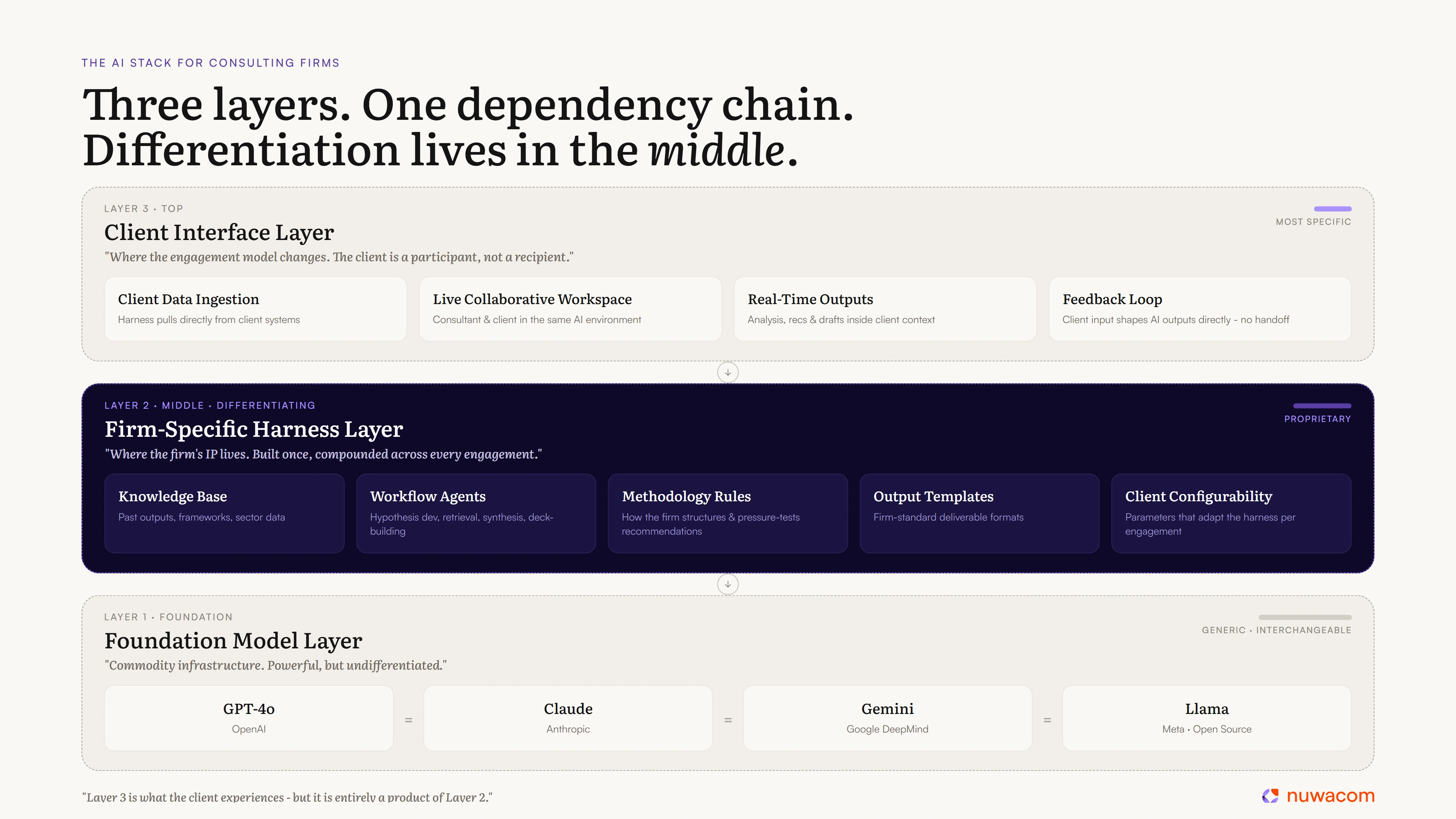
Most firms building AI infrastructure are meeting one of these requirements. Fewer are meeting both. The ones that do, have effectively built the technical foundation for a different type of client relationship - one where the boundary between “our analysis” and “their context” starts to dissolve, and where the consultant’s AI Operating System becomes an extension of the client’s own capability rather than a black box that produces deliverables on a fixed schedule.
That’s not just an efficiency gain. It’s a shift in their value proposition.
Move 2: Rethink How You Deliver Services with AI
Building the AI Operating System is the foundation. What you do with it at the point of client delivery is where the competitive differentiation actually becomes visible.
There are two dimensions to this, and conflating them is a common mistake. The first is internal: using the AI Operating System to change how teams work, how engagements are staffed, how knowledge from past projects is reused rather than reconstructed from scratch every time. The second is external: using it to change the interface between your firm and your client. Both matter. But the second is where most firms haven’t yet gone, and it’s where the more durable advantage lies.
On the internal dimension, the efficiency gains are real and significant. A well-configured AI Operating System compresses the time from data collection to structured insight, from insight to strategic recommendation, from recommendation to polished deliverable. Teams that are used to spending most of an engagement gathering and formatting information can redirect that capacity toward judgment, synthesis, and client interaction - which is, in most cases, where the actual value was always supposed to live. This isn’t a marginal improvement. It changes how engagements are scoped, how they’re staffed, and ultimately how they’re priced.
“The client isn’t a recipient of analysis — they’re a participant in it. That changes the dynamic of the relationship in ways that are difficult to replicate and very difficult to commoditize.”
The external dimension is more consequential. The firms getting this right are not just using AI to produce better outputs that they then hand to clients. They are building shared AI environments that connect the consultant’s infrastructure directly to the client’s data, systems, and teams. The result is an engagement model where the client isn’t a recipient of analysis; they’re a participant in it. That changes the dynamic of the relationship in ways that are difficult to replicate and very difficult to commoditize.
NexStrat.ai is the sharpest current example of this approach executed from the ground up. Founded in 2024 by former Bain and Deloitte partners, the firm built its entire operating model around hypothesis-driven consulting workflows encoded directly into its AI infrastructure - the approach that defines rigorous strategy work, but now running at a pace and scale that the traditional model couldn’t support. By early 2025, they already worked for Fortune 500 firms and major financial institutions, which reflects what happens when the delivery model and the AI infrastructure are designed together rather than retrofitted onto each other.
Other firms are solving specific parts of the problem in ways worth noting. Square Management, a consultancy serving banking, luxury, and aerospace clients, uses Gemini in Google Workspace to match consultants to client engagements more precisely - and has built an internal AI Lab dedicated to developing what they call “augmented consultants.” Apex Leaders has deployed Gemini Enterprise to power an internal search engine across its institutional knowledge base, with automated summarization and content drafting built in, thereby making expertise that used to live in individuals’ heads systematically accessible across the firm.
What these examples have in common isn’t a particular technology choice. It’s a design philosophy: AI is not a layer added to the existing delivery model; it is the architecture the delivery model is built around. The distinction sounds subtle. The operational implications are not.
For mid-tier and boutique firms, this is actually an advantage, not a constraint. Larger firms are retrofitting AI onto legacy structures, client relationships, and billing models that were built for a different era. Smaller firms with genuine domain focus can build the AI Operating System and the delivery model simultaneously - and end up with something more coherent, more specific, and more defensible than anything a generalist firm with a broader AI budget can produce.
Move 3: Build Applied AI Expertise and Sell It
The third move is where the first two become a market position rather than just an operational upgrade.
There is a role that has been quietly spreading across the AI industry for the past few years, and it is now beginning to appear inside consulting firms in ways that signal something more significant than a hiring trend. The Forward Deployed Engineer - FDE - originated at Palantir in the early 2010s under an internal designation for engineers who didn’t sit in the office building product. They sat inside customer organizations, working against real operational complexity from the inside, building and configuring Palantir’s software directly within the client’s environment rather than handing over a finished product and a user manual. The model was deliberately uncomfortable. It required people who could hold deep technical capability and deep contextual understanding simultaneously, and who could operate effectively in the ambiguity of a client organization rather than the relative clarity of a product team.
The pattern has since spread. OpenAI formalized its own FDE practice in 2024, growing from two to thirty-nine FDEs by year end. Anthropic followed. In April 2026, EY launched dedicated Anthropic Forward Deployed Engineer roles in the UK and Ireland; Deloitte is hiring FDEs specifically for Palantir deployments. What began as a Palantir-specific delivery innovation is becoming standard practice across the AI industry - and is now beginning to reshape how the most forward-thinking consulting firms think about their senior talent.
The insight for mid-tier and boutique consulting firms is not that they need to rebrand their consultants as FDEs. It’s that the underlying capability the role describes - combining deep domain expertise with the ability to configure and deploy custom AI setups inside a client organization - is precisely what the consulting model is uniquely positioned to produce, and what the market is beginning to pay a significant premium for.
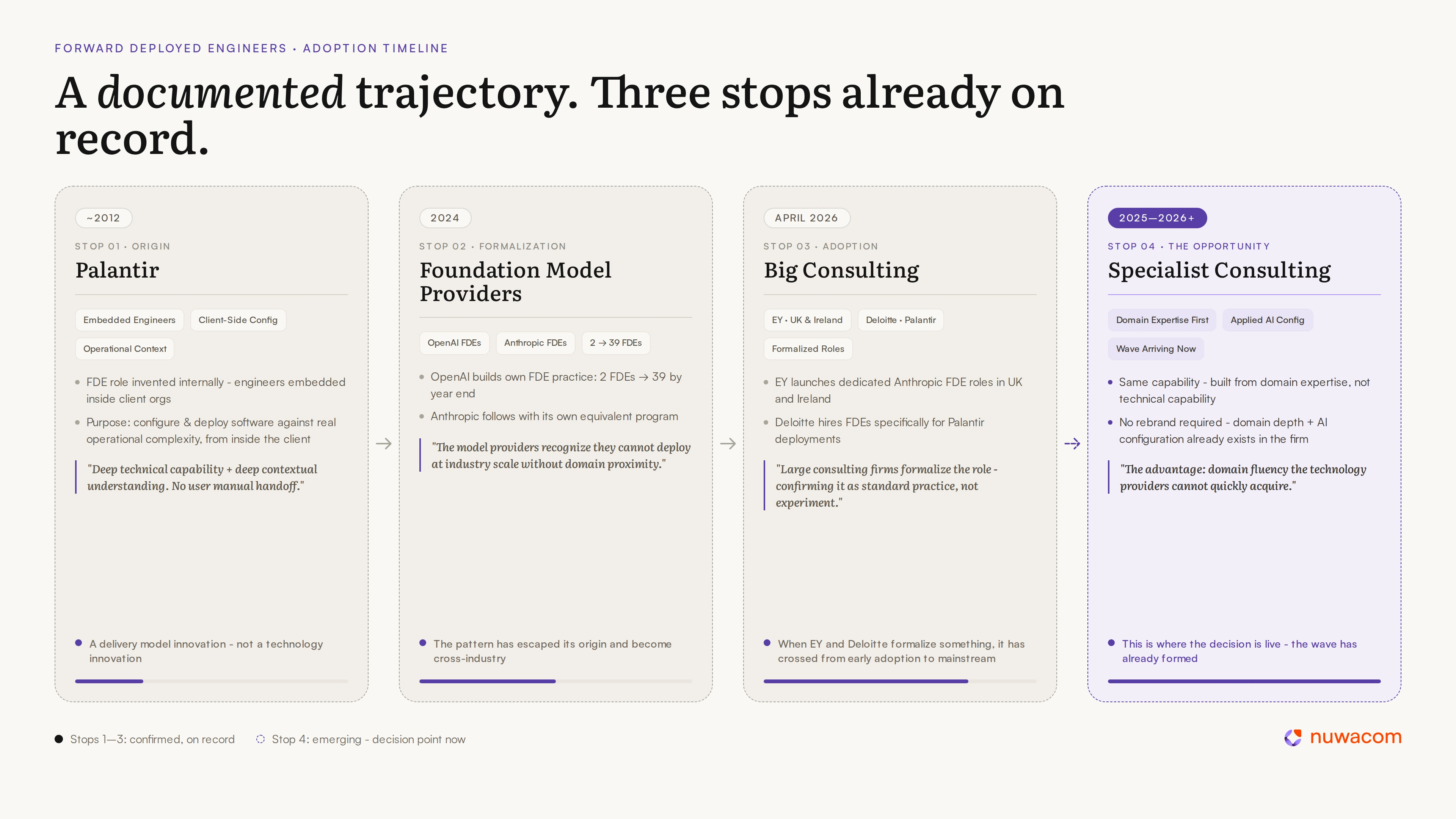 Consider what this actually requires. A consultant who has spent a decade in financial services restructuring, or in pharmaceutical market access, or in supply chain optimization for industrial manufacturers, carries something that no AI platform provider has and cannot quickly acquire: the domain depth to know which questions matter, which data is reliable, which recommendations will survive contact with organizational reality. The technology providers - OpenAI, Anthropic, the specialist platform companies - have the product capability and the engineering sophistication. What they lack is the industry fluency that makes deployment actually work at the level of a complex, specific client problem. That gap is the consulting firm’s opportunity.
The practical build looks like this: identify the consultants within your firm who already have the deepest domain expertise in your focus areas, and invest in developing their applied AI capability - not generically, but specifically in the ability to configure your firm’s AI Operating System to a client’s context and deploy it inside the client’s environment. These are not AI evangelists. They are domain experts who have learned to translate their knowledge into custom AI configurations that work in the messy, constraint-laden reality of a real organization. When you can staff that profile on an engagement, you are offering something qualitatively different from traditional consulting delivery - and something the technology providers cannot credibly replicate without you.
This also unlocks two new revenue and partnership dimensions that the traditional consulting model doesn’t have access to. The first is the ability to embed applied AI expertise directly into client engagements as a distinct workstream - not as a background capability, but as a billable, named component of the project. The second is a partnership channel with technology providers who need exactly what you have: the domain depth and client proximity to make their platforms actually work at industry scale. For a mid-tier or boutique firm with genuine sector focus, this is a meaningful shift - from being a downstream buyer of technology to being a go-to-market partner for the companies building it.
Neither of these revenue streams requires the firm to become a technology company. They require the firm to become very specifically, very deliberately itself - with AI as the amplifier.
The Question Isn’t Whether - It’s Which Direction
There is a version of AI adaptation in consulting that looks convincing from the outside and changes very little on the inside. The tools are there. The slide deck about AI strategy exists. A few senior partners have mentioned it in client conversations. The firm is, in the language of most internal assessments, “actively exploring” the opportunity.
That version leads somewhere, but it doesn’t lead anywhere defensible.
The firms that will remain genuinely relevant in the AI era are not those that adopt AI the fastest in a generic sense. They are the ones that make a specific, deliberate bet on what kind of firm they are building - and then use AI to double-down on that. They use the technology to ingrain their identity and competitive advantage right into their operating model. The three moves described here are not a framework for AI adoption. They are a framework for compounding what is already the consulting firm’s core asset: hard-won domain knowledge, client trust built over years, and the judgment that comes from having seen enough complexity to know what matters and what doesn’t.
“The technology providers have the product capability and the engineering sophistication. What they lack is the industry fluency that makes deployment actually work. That gap is the consulting firm’s opportunity.”
The AI Operating System encodes that knowledge and makes it systematic. The new delivery model puts it in direct contact with client reality rather than wrapping it in a deliverable handed over at the end of an engagement. The applied AI expertise - the FDE capability built from domain depth rather than layered onto it - makes it sellable in new ways and to new partners. Together, they don’t just make the firm more efficient. They make the firm harder to replicate, harder to displace, and significantly more valuable to the clients who need more than a report.
The competitive threat worth taking seriously isn’t a large language model. It’s a competing firm - possibly smaller than yours, possibly newer - that has already built its AI Operating System, already restructured its delivery model around shared client environments, and is already deploying domain-trained applied AI experts inside the organizations you consider your core accounts. That firm exists. In some sectors, it is already winning work.
The question consulting firms need to answer is not whether to adapt. That question has already been answered by the market. The question is whether the adaptation makes the firm more deeply, more specifically itself - or just faster at being generic. One of those compounds. The other converges, eventually, with everything else that can be automated.
The firms that understand the difference are the ones worth watching.