
:format(webp))
:format(webp))
On one hand, because it is scattered across different systems and therefore hard to find. On the other, because part of it exists only in the heads of individual employees and is lost every time someone leaves.
In its State of Teams study, Atlassian found that knowledge workers spend 25% of their working time just searching for information. 49% of the German office workers surveyed also said they regularly cannot continue their work because they are waiting for information or answers from other teams. In most organizations, the problem is therefore not missing knowledge, but the fact that it is hard to find.
Traditionally, individual employees act as the go-to contact for hard-to-find information. That is precisely what turns them into a bottleneck: a model that does not scale and depends heavily on the availability of a few people.
“Our archivist is always the bottleneck, the one who really finds everything. But she has to be asked, and she has to be available.”— Rolf Bewersdorf
Teams that regularly need access to historical and subject-matter information, such as marketing, communications, HR, or compliance, are held up most by the lack of access.
“The problem in most organizations isn’t missing knowledge at all, it’s the missing access.”— Sascha Böhr
Just how deep this access problem can run is shown by the corporate communications team at Lufthansa Group: a team that literally sits on 100 years of knowledge and still couldn’t always get to it.
Webinar recording
On August 26 in our webinar, Rolf Bewersdorf, Senior Manager Communications Infrastructure at Lufthansa Group, showed how they solved it.
The Lufthansa Archive as a Data Foundation for AI
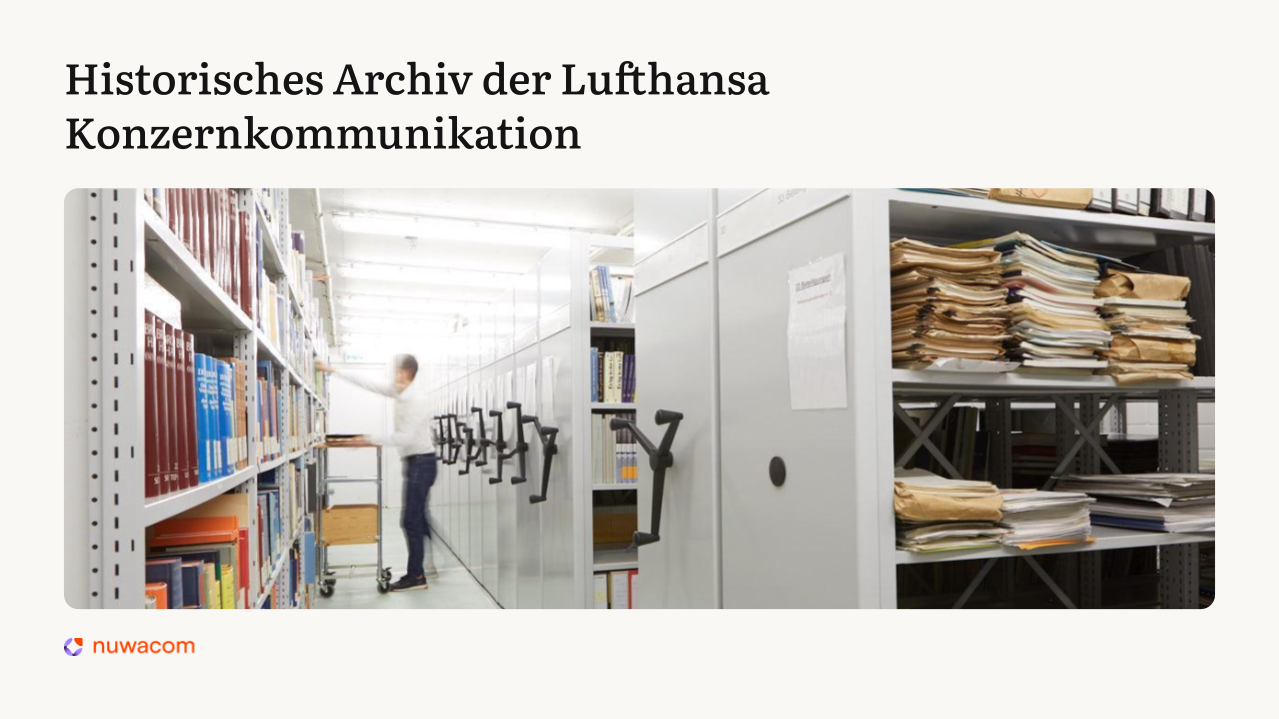
The historical archive of Lufthansa’s corporate communications sits in the basement of the group headquarters in Frankfurt, spans 1,200 linear meters of files, and had only been partially digitized. The documents go back to 1919 and include founding documents, annual reports, technical documentation, and staff newspapers such as the Lufthanseat, which was published from 1933 into the 1990s.
Because finding information in the physical archive had become a challenge, the team began building an AIS, an archive information system, in 2006. Since there was no affordable solution on the market at the time, the entire project was developed in-house. Priority went to all documents that were relevant to daily work and carried high communicative or historical value.
In total, around 5% of the holdings, roughly 100,000 documents, were digitized and made searchable. Filing followed the principle of provenance, meaning the context in which the documents were created, to guarantee clear attribution.
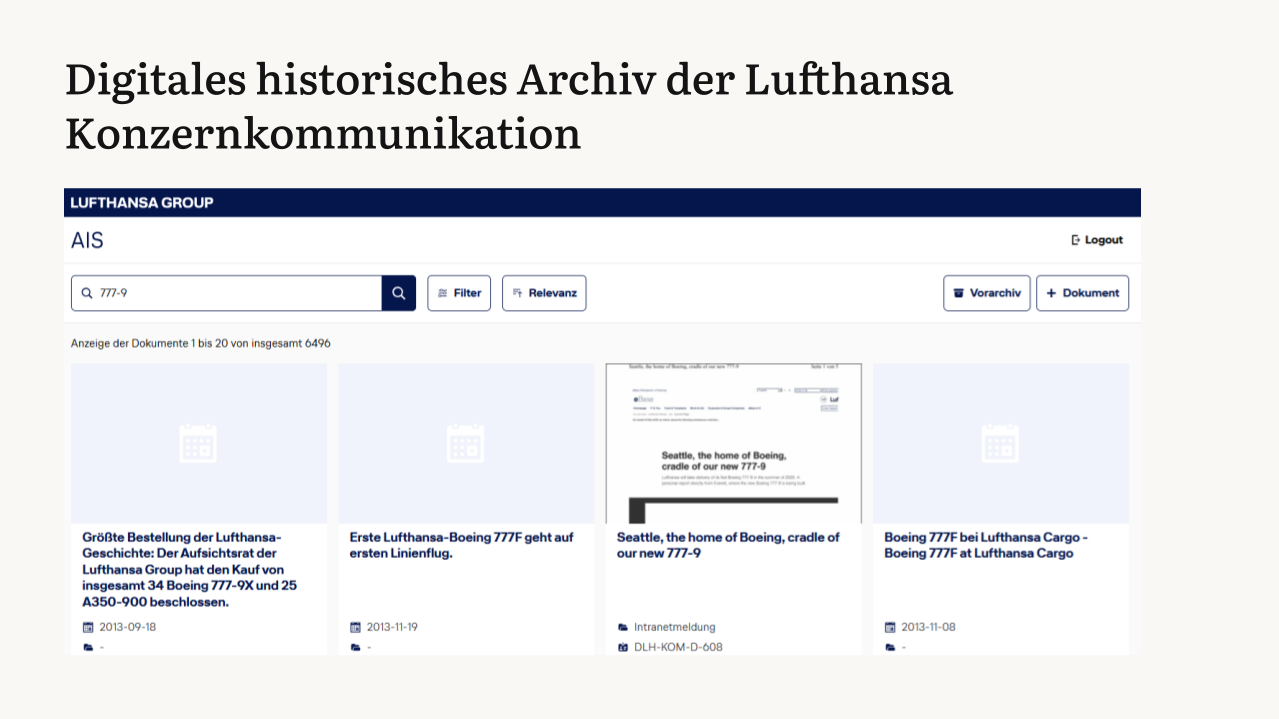
To keep the documents usable over the long term, the archive was built according to the OAIS standard (Open Archival Information System), a framework for long-term archiving. The documents themselves were stored in PDF/A format, which is designed for lasting legibility. The archive was solid and future-proof. But the actual problem remained: access.
The system still placed high demands on employees. To get useful answers, they had to:
know the right keyword
understand the archive structure
know the context of the document
use Boolean operators where necessary
“You still find things poorly. It takes quite a long time before you’ve really found a document.”— Rolf Bewersdorf
And anyone who didn’t find the answer in the end was back to relying on the archivist. With the introduction of AI, that changed.
The Technical Implementation: How the Lufthansa Archive Was Connected to nuwacom
To let employees ask more abstract questions and work in natural language, the communications team decided to connect AI to the archive.
What sounds simple in theory required, in practice, an interface between the archive and nuwacom. The 100,000 documents were vectorized and thereby made findable for users inside nuwacom.
The existing archive is not replaced in the process, but remains the central source for archived documents. New documents are synchronized with nuwacom within a few hours.
Before a single document landed in nuwacom, the entire collection was classified into Public, Internal, and Admin. Access control was built in from the start.
Public: publicly accessible or released content
Internal: internal information
Admin: content with especially sensitive data or for administrative purposes
Anything classified as confidential was not carried over into the AI knowledge management system.
Hybrid Search and RAG: From the Archive to the Right Contextual Knowledge
For most queries, searching all 100,000 documents is not practical. It blows past the context window and rarely leads anywhere useful. A smaller document set makes processing easier for the AI and reduces the risk that important information gets lost.
Instead, the team uses hybrid search: a combination of classic search across the structured knowledge base and semantic search. The AI therefore considers not only exactly matching terms, but also the context of a query.
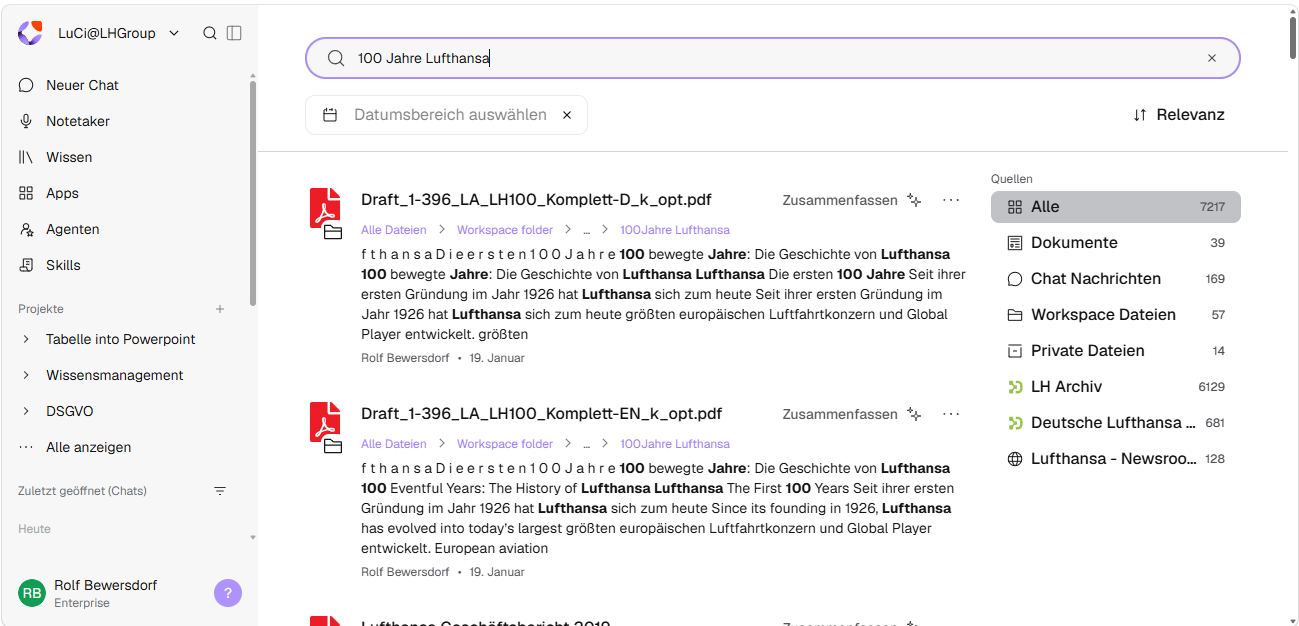
As an example, Rolf put a query on the topic of “100 Years of Lufthansa” to the archive during the webinar:
semantic search scans the existing document holdings
relevant documents are assembled as a preselection
the document set is handed to the chat or bundled in a project folder
this folder forms the contextual knowledge for the AI’s further work
the AI then answers questions and creates content based on the curated context
“An AI can’t search 100,000 documents at once and then give exactly the right answer like Wikipedia. You have to approach the desired result step by step.”— Rolf Bewersdorf
This principle, drawing answers from existing documents rather than from training data alone, is based on RAG (Retrieval Augmented Generation). The AI accesses fitting documents in a targeted way. Results become more relevant and are anchored in official company information.
Set up correctly, RAG can sharply reduce the risk of hallucinations.
The “100 Years of Lufthansa” Case: What Became Possible with the System
Lufthansa Group recently celebrated its 100th anniversary. The jubilee became the practical test for the new AI-supported knowledge management. Numerous events needed visual and communicative support, and the team prepared exhibitions, press events, and many further communications measures. A book was even created for the occasion.
According to Rolf Bewersdorf, all of this would hardly have been possible on this scale without AI. All relevant documents were bundled in one project and formed the basis for numerous assets. The activities AI supported included:
creating information packages
gathering historical information for communications measures
preparing exhibitions
structuring publications
revising speeches
fact-checking
“We couldn’t have staged these anniversary celebrations this way at all. It supported us enormously.”— Rolf Bewersdorf
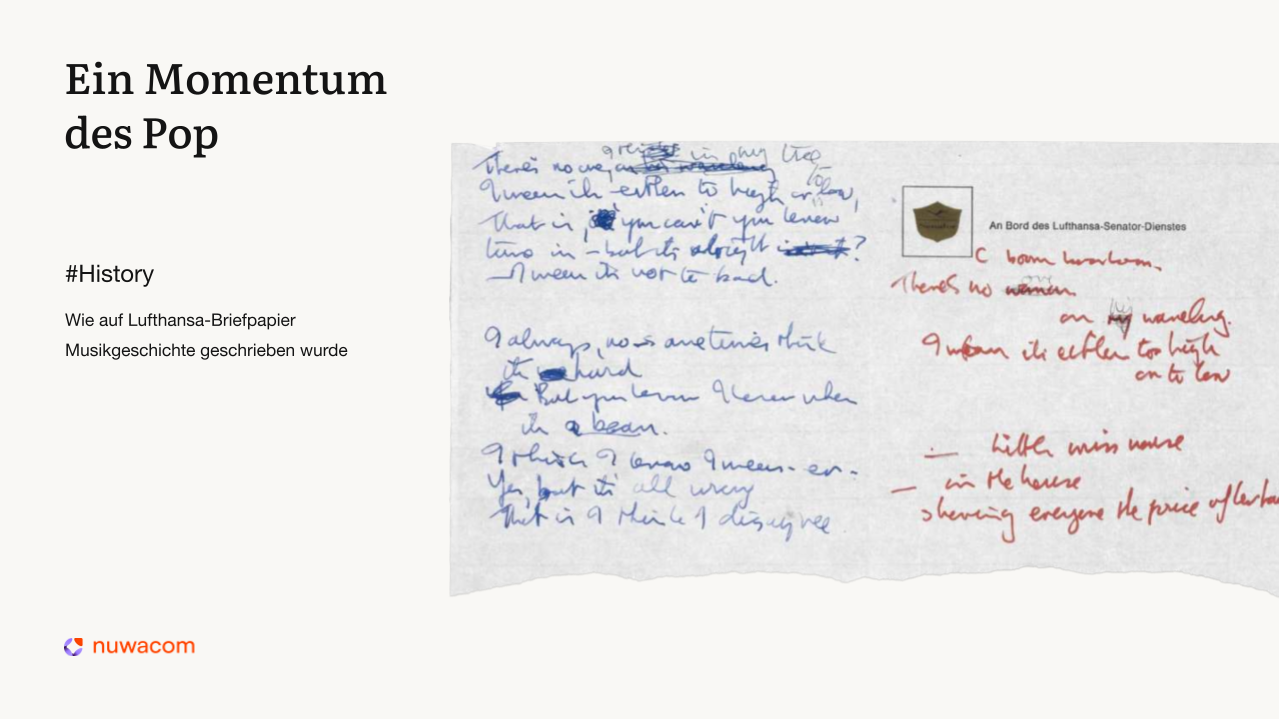
While the AI accelerated the search for information, it also surfaced new, unexpected stories, such as the connection between John Lennon and Lufthansa. The musician wrote the lyrics to Strawberry Fields on Lufthansa stationery, which today sits in a London museum. A treasure for communications that would have been hard to find in the archive without AI.
Editors also benefit from suggestions, overviews, and structure when writing new articles. But the real lever was working together: the documents assembled for the anniversary were bundled in a project folder and shared with the team. There, everyone could upload further documents and put their questions directly to this collection, instead of each person researching alone.
Governance and Data Protection: What Had to Be Clarified Before Deployment
Lufthansa Group had already begun engaging with AI in 2023. Before productive use, however, several hurdles had to be cleared: data security, data protection, copyright, transparency, and more. The team went through more than 30 committees, some of which had only just been created, such as the committee of AI experts.
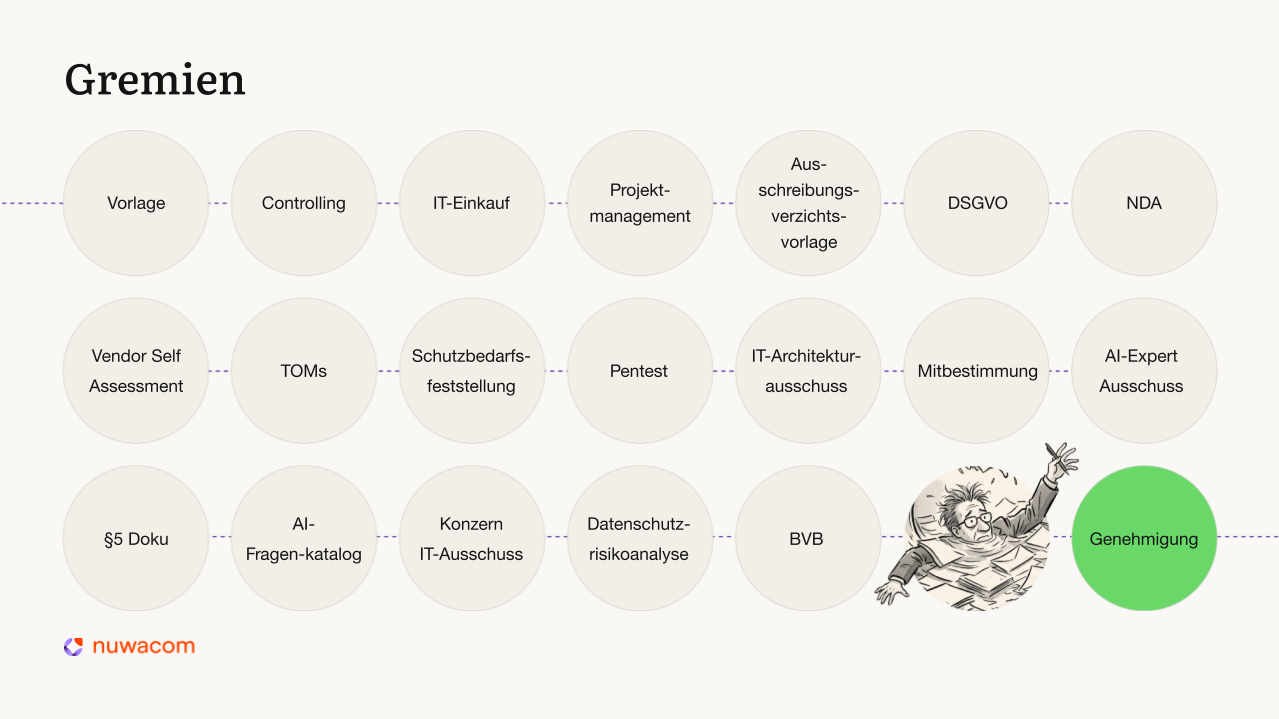
In the end, the team found in nuwacom a solution that met all requirements, including the security requirements for:
a protected environment
EU hosting
no use of company data for training purposes
In addition, governance structures were created that ensure AI use is legally protected and meets the requirements of the EU AI Act.
AI provides support, but subject-matter review remains with the knowledgeable colleagues. Especially for statements that are historically, legally, or otherwise binding, the AI must never act as the sole authority.
Technology Alone Is Insufficient
The introduction of AI initially prompted mixed reactions among employees. Some were curious and expected to be able to get everything done at the push of a button. Others found the new technology more unsettling.
A typical adoption problem in many organizations: employees respond differently to new technology. Some enthusiastic users start experimenting right away, while others ignore it at first.
“We realized we had to get close to the topic through training and through hands-on experience, very much so.”— Rolf Bewersdorf
Through workshops, Lufthansa made sure all employees could learn how to use AI sensibly and make their working day easier. The Promptathon was especially well received, a workshop in which the IPO of a fictional company was prepared with the help of AI. Through application-oriented learning, employees had quick moments of success and learned prompts and ways of working they could transfer to their own daily routine.
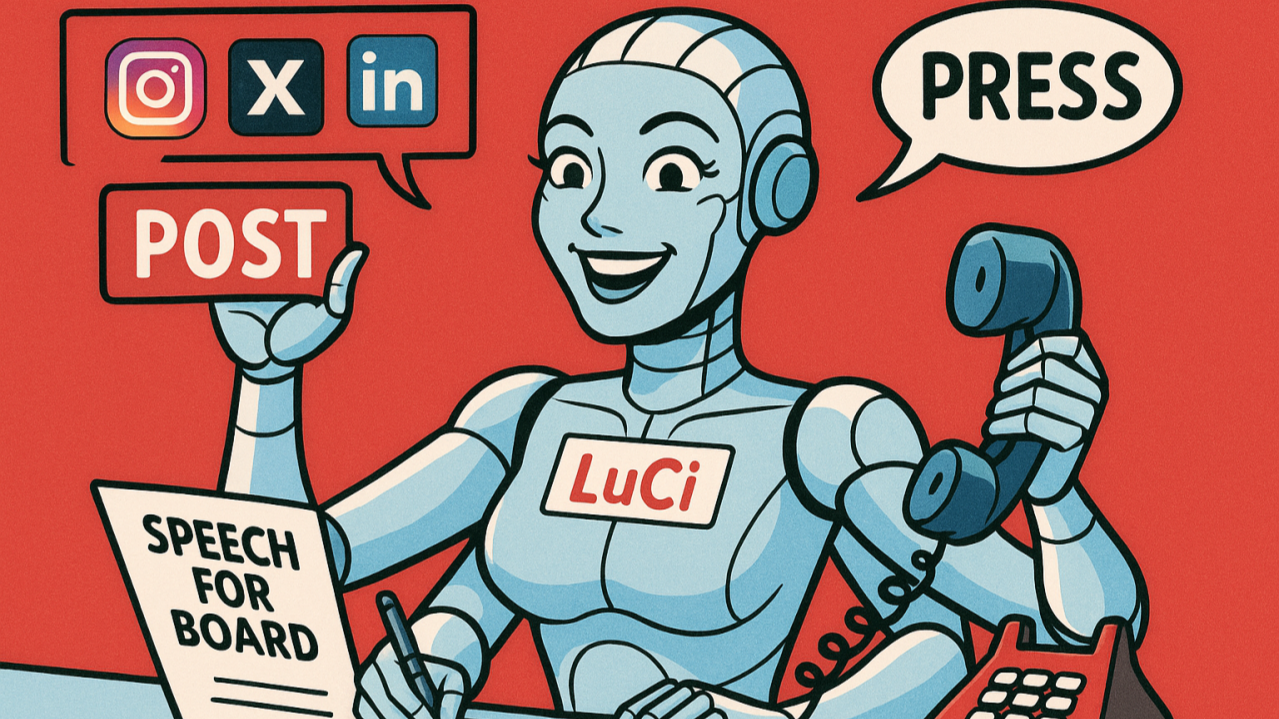
The AI also got a name and is now known as LuCi, a combination of Lufthansa and the abbreviation for corporate communications, and at the same time a nod to the Luc Besson film in which Lucy (Scarlett Johansson) becomes an almost all-knowing, superintelligent entity.
LuCi has since become a common tool: 75% of the group communications staff open it on average three times a day. Another, qualitative sign of growing acceptance is the use cases that the teams themselves bring to Rolf’s team. In so-called LuCi Hacks, employees are invited to develop their own use cases and work them out together. This too shows that LuCi is increasingly arriving in everyday work.
What Comes Next?
Access to knowledge is the first step. The next is to connect that knowledge directly to creation, coordination, and publication.
This is exactly where the next step for Lufthansa Group’s corporate communications comes in: they want to organize communications planning within nuwacom as well. To do this, the existing planning board in Trello is to be connected to the nuwacom environment, so that concrete planning can be derived directly from researched information.
This becomes possible through the native Trello connector: cards can be searched, managed, and created as tasks directly from within nuwacom’s chat. Both directions are conceivable, from evaluating a board for the executive board to feeding finished communications measures back into the planning, so that colleagues can pick up the work directly.
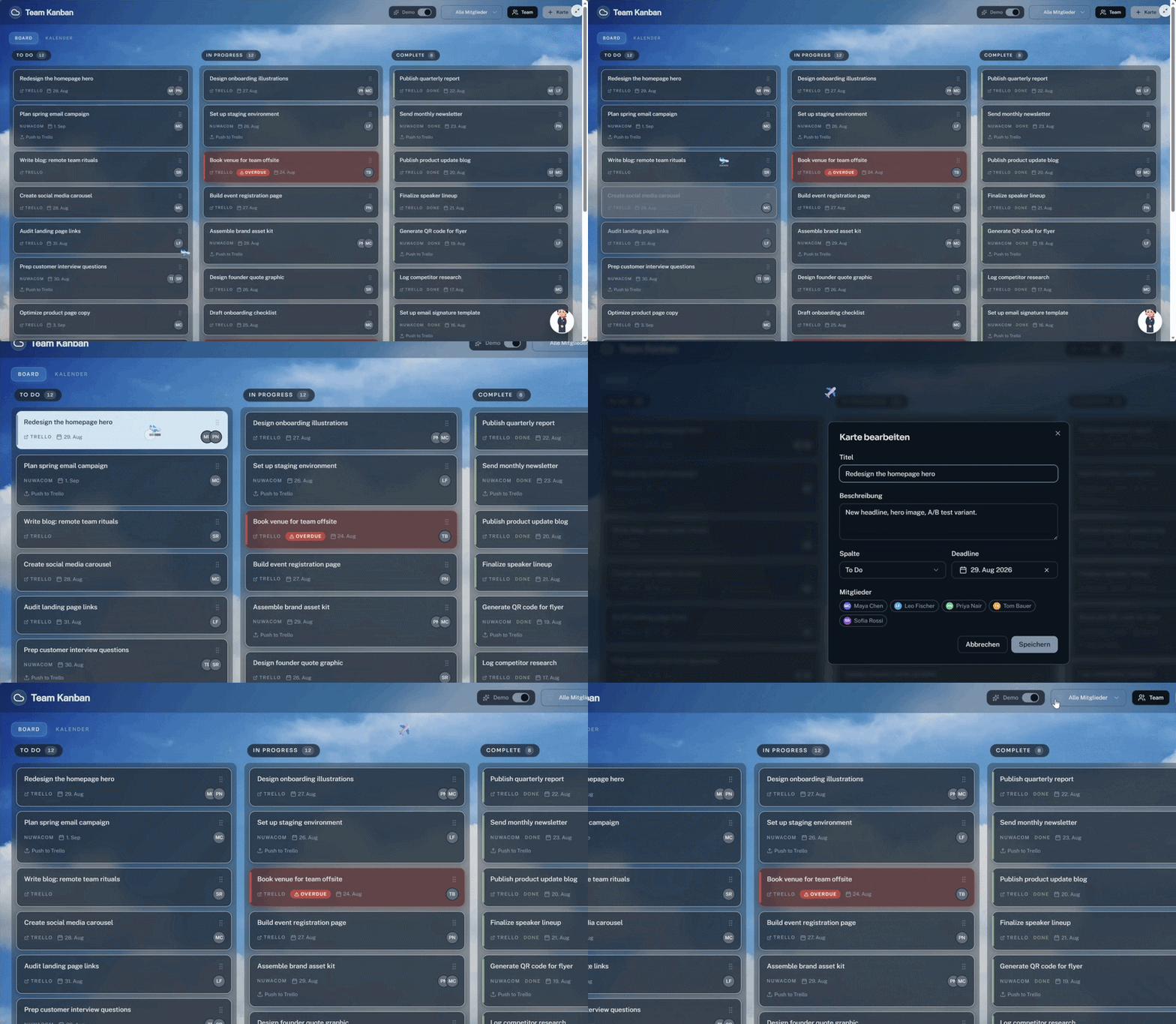
One possible app picking up on the idea of a kanban could bundle Trello tasks with tasks created in nuwacom and add an AI assistant for planning. That way knowledge does not stay in an isolated archive, but flows into the ongoing work process.
LLM Wikis: The Step from Archive to Networked Knowledge
Another trend topic that Lufthansa and nuwacom have their eye on is so-called LLM Wikis, an architectural pattern coined by AI expert Andrej Karpathy.
The idea: instead of searching documents only when a query comes in (as with RAG), an LLM converts the holdings into a structured knowledge base in advance. From the individual documents, summaries of topics and articles are generated automatically, stored in Markdown format and linked to one another. Knowledge is thus synthesized not only during search, but already at the point of ingestion.
The Lufthansa archive illustrates this well: an annual report can be linked to an anniversary, a person, or a specific communications measure. A kind of knowledge graph emerges, in which the AI no longer just finds individual documents, but also establishes historical and thematic connections. Because machine-readable Markdown sits behind the articles, answer quality improves on top of that.
“Initial tests show that this raises the quality of the answers massively once again.”— Sascha Böhr
An LLM Wiki thus works like a classic wiki, with the difference that it is generated and maintained by AI. In combination with classic knowledge management, this creates something we at nuwacom call organizational memory.
Lessons from the Lufthansa Example
The Lufthansa Group case shows one thing above all: successful knowledge management is more than choosing the right technology. It does not begin with the latest model, but with a solid data foundation and a clearly bounded use case that is expanded step by step.
The people are just as decisive. For AI to genuinely arrive in everyday work, employees need to be trained in practice and enabled to experiment, without immediate pressure on productivity.
Every organization is structured differently, and the concrete architecture looks correspondingly different. But the underlying principles of the approach are transferable:
Structure: create a reliable, well-maintained data foundation
Bound: work with a curated, clearly delimited context rather than the entire collection
Verify: make sources traceable and keep subject-matter sign-off with people
Enable: bring employees to the technology in a hands-on way
Scale gradually: measure and learn first, then expand
Where in your organization does knowledge exist in principle, but still fail to become accessible fast enough in everyday work?
You can find the recording of the webinar here.
Questions from the Webinar
Were all documents from the Lufthansa archive really carried over into the nuwacom knowledge base?
No. The documents were classified and around 70% were synchronized. All sensitive information was excluded, for example accident records. All new, suitable documents are automatically added to the knowledge base.
How do you ensure the AI doesn’t just deliver plausible answers quickly, but always uses current, authorized, and traceably documented information in security, compliance, or business-critical cases, and who bears responsibility when an answer is wrong or misleading?
All sources used are listed in the answers and directly viewable. Final review and sign-off must always rest with people. AI eases the preparation, but cannot carry the final responsibility.
How do you address the implicit experiential knowledge that is especially relevant for operations, safety, and customer focus but isn’t written down in documents? Which concrete formats and incentives do you use so that employees voluntarily externalize this knowledge, reflect on it together, and make it usable for others, rather than merely making existing documents searchable with AI?
nuwacom gets to know the organization better through employees’ daily work with the system. The Context Engine uses different methods, among them Memory, RAG, vector search, and meeting notes, to continuously develop the context further. Beyond that, it has proven valuable to closely involve the knowledge holders in developing tools such as Skills and Agents, because it is precisely this implicit knowledge that often gets encoded in their instructions. Our customers frequently solve this by having departments name AI champions who are responsible for building these tools and then work closely with their colleagues.
How much subject-matter context was necessary to make the documents usable for AI?
The existing archive structure with metadata, provenance, and document classifications formed the subject-matter foundation. nuwacom handled the technical vectorization and made the released content accessible via semantic search.
On whose servers is the data stored?
The data is hosted in Europe or Germany as configured by the customer, among others in the Azure Cloud.
Is data passed on to the operators of the AI models?
The models are hosted by nuwacom, and data is never used for training purposes.
How do you prevent the AI from outputting confidential information?
Through the initial classification of the documents, confidential information is excluded from what the AI can access from the very start. In addition, access rights ensure that employees only see what they are authorized to see.
Can every answer be traced back to the specific source document?
With every answer, the AI states its sources, which makes it possible to trace it back to the specific source document.
How does the AI handle contradictory versions of the same matter?
The AI should flag contradictory sources and name the underlying documents, rather than independently declaring one version correct. Subject-matter review and the decision stay with the responsible employees.