What happens when AI stops assisting... and starts completing work?
Most AI tools today are reactive. They wait for a prompt, return a single output, and stop. The user is still responsible for breaking down the task, sequencing the steps, gathering the inputs, and assembling the final result.
That is not automation. That is assistance with extra steps.
The shift happens when AI can take a goal, not a prompt, but a goal, and decompose it into subtasks, coordinate multiple agents, run steps in parallel, pull from existing company knowledge, and stay involved until the result is delivered. Not one answer at a time. An entire workflow, end to end.
This is the difference between an AI assistant and an AI agent. An assistant answers questions. An agent completes work. The industry calls this shift "agentic AI," and it changes what teams can accomplish in a day.
From a daily morning briefing compiled from five sources to a full campaign launch package assembled across departments — the question is no longer "what can AI help with?" It is "what can AI finish?"
Why does AI still feel like extra work for most teams?
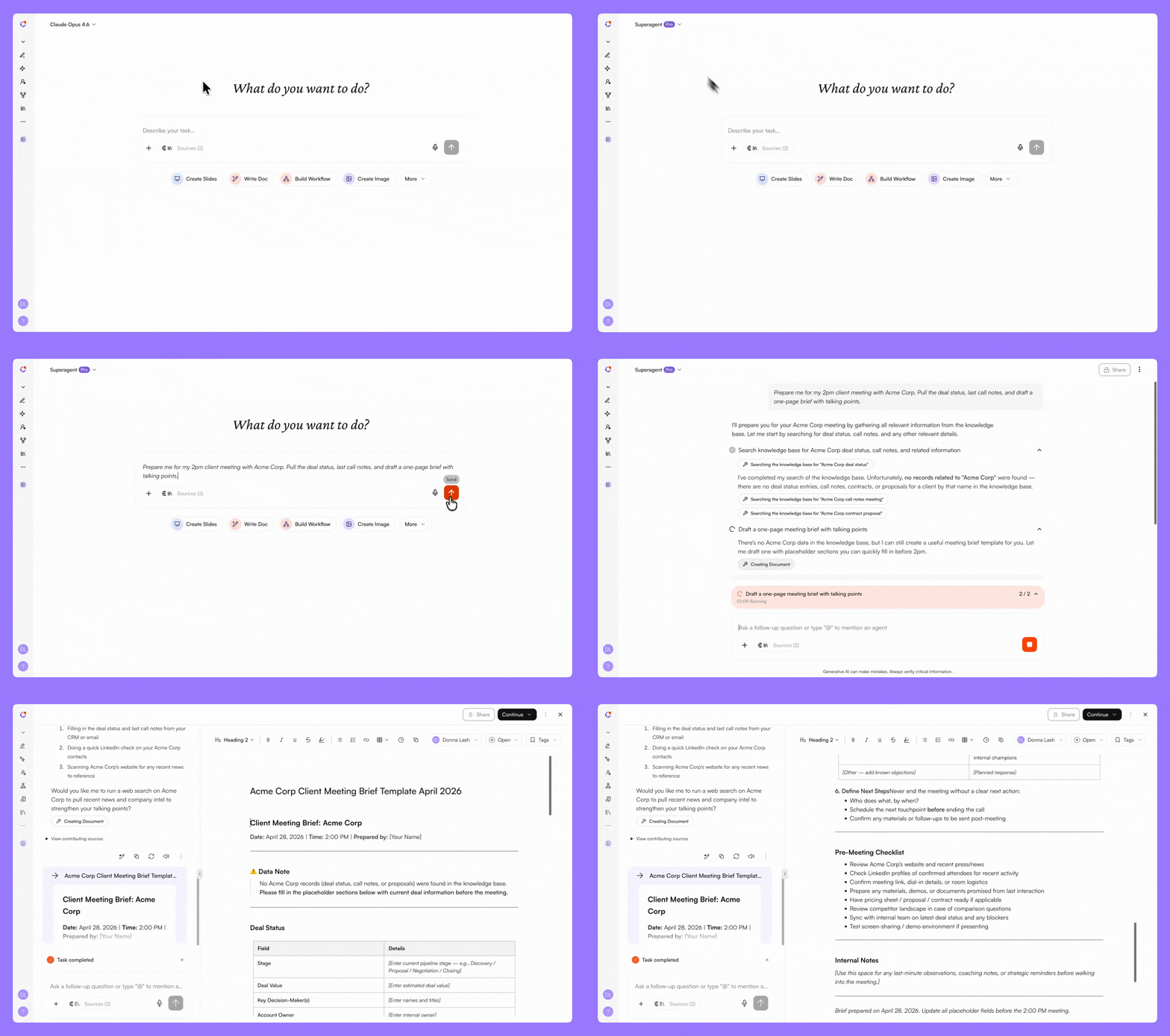
Here is a scenario most knowledge workers recognize. You need to prepare for a client meeting. So you open your calendar to check who is attending. You switch to your CRM for the latest deal status. You dig through Slack for the thread where your colleague shared notes from the last call. You search email for the proposal you sent two weeks ago. Then you open ChatGPT, paste in fragments of all of this, and ask it to summarize.
Thirty minutes later, you have a mediocre summary built from incomplete context. You spent more time gathering inputs than the AI spent generating outputs.
This is the norm, not the exception. McKinsey estimates that fragmented knowledge costs companies USD 200 billion annually in duplicated work and lost institutional knowledge. AI has not fixed this. In most organizations, it has added another disconnected tool to the pile.
The OpenAI State of Enterprise AI 2025 Report found that 80% of enterprise AI usage remains basic chat. Single prompts, single answers, no memory, no follow-through. Ask a question, get a response, start from zero next time.
The gap is not intelligence. AI models are remarkably capable. The gap is continuity — the ability to remember, plan, coordinate, and finish.
What is the Superagent and why does it exist?
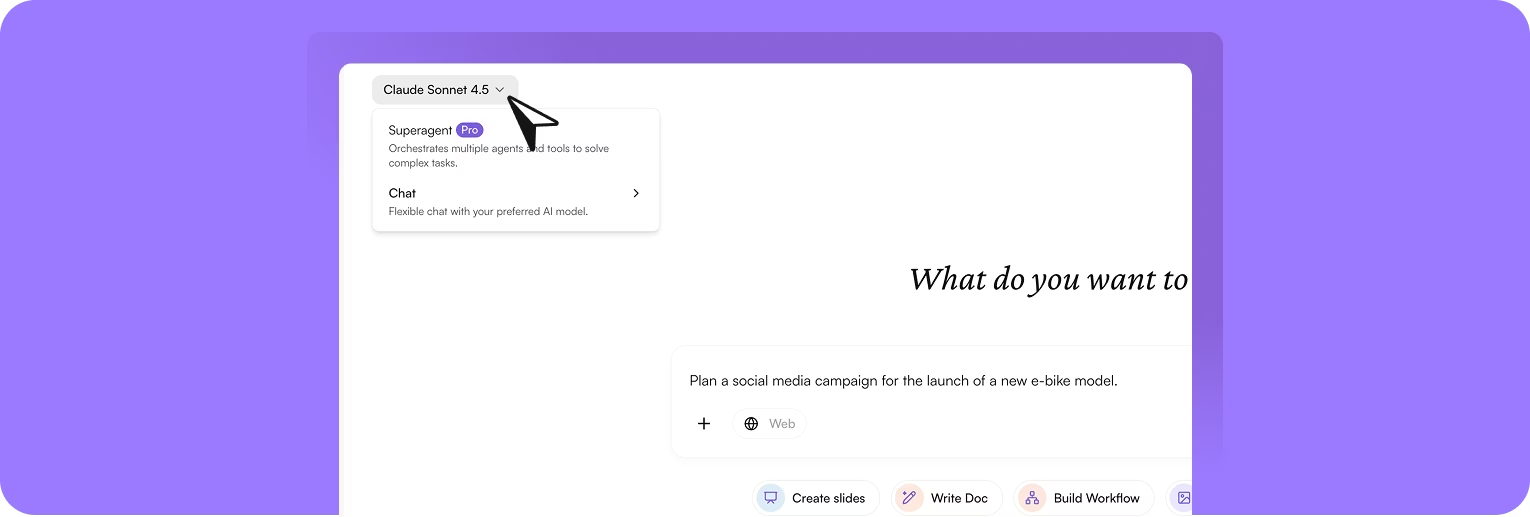
A Superagent is an AI orchestration layer that coordinates multiple agents, tools, and data sources to complete complex, multi-step work autonomously. It is not a chatbot. It is not a single-purpose assistant. It is the layer that turns AI from something you talk to into something that works for you.
The nuwacom Superagent is selected by default in the Chat when a task is too complex for a single prompt — when it involves research, writing, data from multiple sources, formatting, and delivery — the Superagent takes over.
Think of it as a senior project lead that happens to work at machine speed. Some tasks wait for each other. Some run in parallel. The Superagent knows the difference.
When a user makes a request, the Superagent:
Breaks the work into discrete tasks.
Identifies dependencies — what must happen first, what can run simultaneously.
Assigns each task to the right AI agent or tool.
Pulls relevant data from your company's Corporate Brain — meetings, documents, decisions, emails.
Coordinates execution until the outcome is delivered.
Logs every completed task in your History for full transparency.
The result is not a chat reply. It is finished work — a complete briefing, a prepared proposal, a campaign package with slides, documents, and visuals.
The Superagent does not produce a single reply and step aside. It plans the work, understands dependencies, runs tasks in parallel when possible, and stays involved until the outcome is delivered.
What does AI agent orchestration look like in practice?
What powers the Superagent? The Corporate Brain
Every orchestration system is only as good as the knowledge it operates on. The Superagent is powered by nuwacom's Corporate Brain — a persistent, always-updated intelligence layer that stores and connects everything your company knows.
The Corporate Brain is not a static database. It is a living memory that accumulates context across people, teams, and time. It stores documents, messages, meetings, emails, decisions, and the outputs of every workflow your team has run. This information stays active and shared. Context carries over between people, teams, and tasks.
Four properties make the Corporate Brain fundamentally different from uploading files into a chatbot:
Understands your business. It learns your brand voice, team structure, processes, and goals. New projects start with the brain already understanding what matters.
Remembers everything. Every document, meeting, chat, and decision gets stored. No manual knowledge management — it just remembers.
Connects what it knows. The brain links related projects, recalls past work, and surfaces relevant expertise. Your Q4 campaign automatically recalls Q2 results and Sales' customer insights.
Gets smarter over time. The more your team works, the more the brain understands. New hires tap into years of institutional memory. Veterans find answers in seconds.
What makes the Superagent different is not the workspace — it is the intelligence engine underneath. The Corporate Brain understands your business and remembers everything your team does.
AI Superagent vs. chat-based AI tools
There is an important difference between a chatbot with plugins and an enterprise-grade AI workspace where teams do real work together with AI.
Chat-based AI tools like ChatGPT and Claude are useful for one-off questions, but they have no lasting company memory. Each session is isolated. Every conversation starts from zero. They do not know your products, your processes, your customers, or your history.
Embedded AI like Microsoft Copilot works inside single apps, but context stays split across tools. There is no shared intelligence layer. Copilot inside PowerPoint does not know what happened in your Slack channels. Copilot in Outlook cannot reference a decision made in Confluence.
The nuwacom Superagent is architecturally different. It operates across your entire work environment — documents, slides, emails, meetings, calendars, project management tools — and draws from a single Corporate Brain that connects all of it. When the Superagent prepares you for a meeting, it does not ask you to paste in context. It already has the context.
How does nuwacom compare to other AI agent platforms?
Capability | Chat-Based AI (ChatGPT, Claude) | nuwacom Superagent |
Multi-step task execution | No — single prompt, single response | Yes — breaks work into tasks, runs to completion |
Persistent company memory | No — resets every session | Yes — Corporate Brain remembers everything |
Cross-tool data access | No — limited to chat window | Yes — connects Drive, Slack, Jira, Outlook, Confluence, Notion, and more |
Agent orchestration | No | Yes — coordinates multiple specialized agents in parallel |
Scheduled/recurring tasks | No | Yes — daily, weekly, or trigger-based |
Task history and audit trail | No | Yes — all tasks logged in History |
EU-hosted, GDPR compliant | Varies | Yes — 100% EU-hosted, zero data sharing for training |